



- ★ Meet us at CPHI Americas in Philadelphia, 02-04 June 2026, at Stall 100 ★ Join us at West Africa Pharma and Healthcare Expo, Accra, 06-08 May 2026 ★
- +91-9216300566
- +91-9888421594
- connect.biofield@gmail.com

How to Choose a Third-Party Pharma Manufacturing Company for Specialty Products?
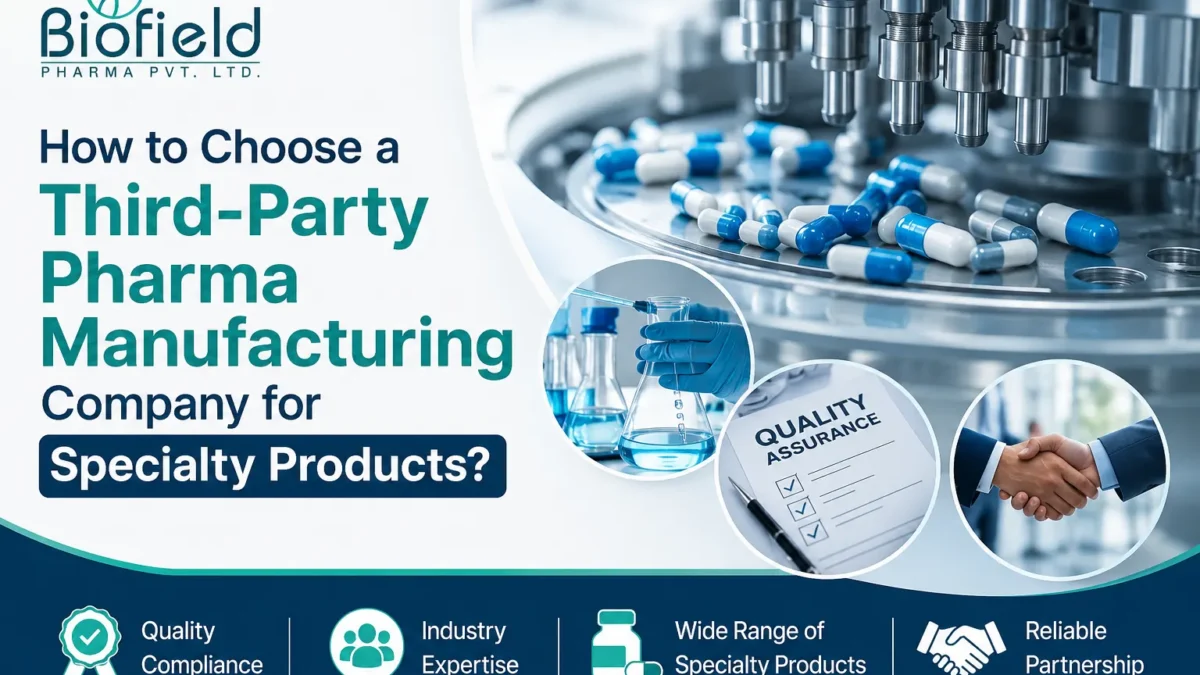
The pharmaceutical industry is becoming more specialised, and companies are increasingly looking for manufacturing partners that can handle the products designed for specific therapeutic segments. From dermatology and orthopaedics to paediatrics, gynaecology, ophthalmology, cardiac care, and injectables. In this blog, we will discuss how to choose a third-party pharma manufacturing company for specialty products.
For pharma marketers and businesses, choosing the right third-party pharma manufacturing company for the specialty products is an important decision. A manufacturer is not simply responsible for producing the medicines. The right partner should also provide quality assurance, regulatory support, product development, packaging solutions and dependable delivery.
Biofiled Pharma works across multiple pharmaceutical segments and offers third party manufacturing and related support for the domestic and international markets. The company states that it has a portfolio of 950+ branded products and more than 10,000 product approvals for third-party manufacturing.
What is Third-Party Pharma Manufacturing?
Third-party pharma manufacturing is a business arrangement in which a pharmaceutical company gets its product manufactured by another qualified manufacturing organisation instead of operating a complete manufacturing facility. The marketing company focuses on areas such as branding, sales, distribution, and promotion. Because the manufacturing partner manages the production and associated quality processes.
These services are useful for the companies entering speciality segments because establishing dedicated infrastructure for every dosage form and therapeutic category can require significant investment. A good manufacturing partner can help businesses bring products to the market while maintaining greater focus on sales and market development.
Why is Choosing the Right Manufacturer Important for Specialty Products?
Specialty medicines have specific formulation, manufacturing, packaging, and quality requirements. A manufacturer that is suitable for one product category is not necessarily the right choice for another. For example, a company planning to develop dermatology products needs appropriate facilities for creams, gels, lotions, and ointments. A business working in paediatrics needs liquid or dry syrup capabilities. While an injectable product requires specialised manufacturing.
Check The Manufacturer’s Manufacturing Infrastructure
The first thing to evaluate is the manufacturing infrastructure. You should look for a company with suitable facilities, production equipment, trained personnel, quality control systems, and appropriate manufacturing capabilities for your product category.
Evaluate Quality Standards and Testing Procedures
Quality should never be treated as a secondary factor when selecting the third party manufacturer. You should ask about raw material testing, in-process quality checks, finished product testing, batch documents, stability testing, and certificates of analysis.
Look for Experience in Your Specialty Segment
Experience matters because the different therapeutic segments have different product requirements. If your business focuses on dermatology, look for a manufacturer experienced in topical formulations. If you are building a paediatric range, check whether the manufacturer handles syrups and dry syrups. A broad product portfolio can also make it easy for a company to expand its range with the same manufacturing partner.
Check the Product Portfolio
A strong product portfolio can tell you a lot about the manufacturing capabilities. You should look beyond the number of products and check whether the company offers relevant molecules, dosage forms, therapeutic categories, and combinations that match your business requirements.
For the specialty focused on business, this can be useful because you may not have to search for a separate manufacturer every time you want to expand into the related product categories.
Understand Packaging and Branding Support
For specialty products, packaging is more than an attractive design. It should provide appropriate product information, protection, identification, and ease of handling. Ask whether the manufacturer can support:
- Product and brand design
- Appropriate packaging formats
- Labels and the cartons
- Batch details
- Product information
- Customized packaging requirements.
Check the Documents and Regulatory Support
Pharmaceutical manufacturing involves proper documentation. Before signing an agreement, you have to understand the documents you have to provide and what are the responsibilities your company has.
Depending on the product and the market, documents include the manufacturing agreement, licenses, batch records, test reports, certificate of analysis, product specification, and other regulatory documents.
Compare the Prices, MOQs, and Production Timelines
The cost is important, but it should not be the only deciding factor. When comparing the manufacturers, you should look at the complete commercial picture of:
- MOQs
- Manufacturing cost
- Packaging cost
- Testing charge
- Transportation
- Applicable taxes
- Payment terms
- Production timeline
Ask About the Inventory and Delivery Support
The availability of the product can directly affect the sales and the distribution network. If a manufacturer maintains the inventory or has access to the raw materials and the production capacity, you can have repeat orders. Biofiled Pharma states that it maintains the inventory and we have in-house manufacturing capabilities to help you. It also highlights the dedicated account management and the after sales support.
Final Thoughts!
Choosing the third party pharma manufacturing company for specialty products needs more than comparing the quotations. Businesses should carefully evaluate the manufacturing infrastructure, quality systems, speciality experience, product range, documents, packing, price, capacity, and the delivery services.
The right partner should be able to grow with your business and provide consistent support as your product portfolio expands. If you are planning to launch or expand your specialty pharma business, Biofiled Pharma can be a good pick for you.